
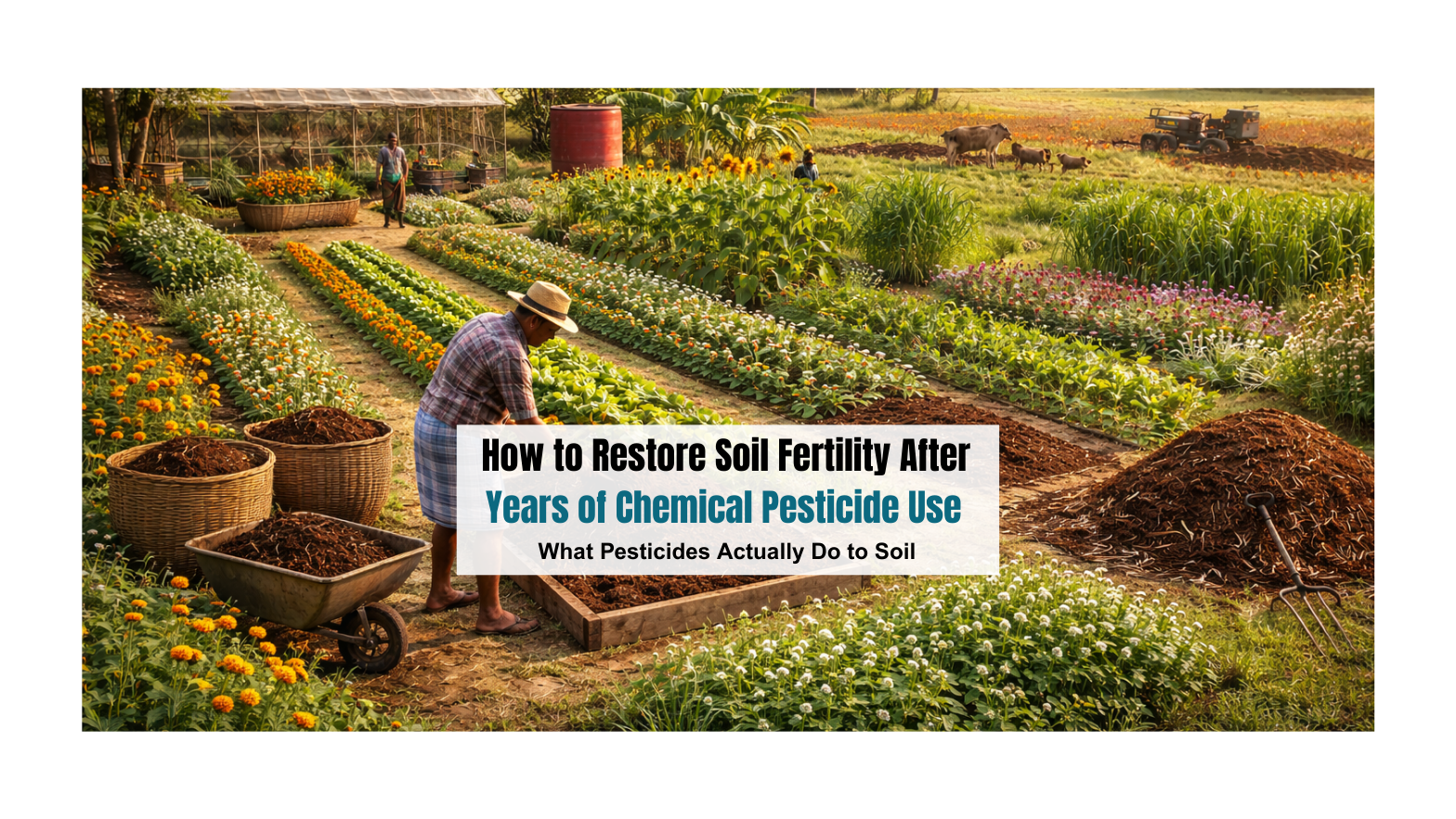

How to Restore Soil Fertility After Years of Chemical Pesticide Use
Amit Kumar stood at the edge of his fifteen-acre wheat field in Bathinda, Punjab, watching the morning sun illuminate what should have been a promising crop. His grandfather had worked this same land, pulling abundant harvests from soil so rich it crumbled like dark chocolate between your fingers. Now, despite applying more urea, more pesticides, and more money than ever before, Amit’s yields had dropped thirty percent in just five years. The earth beneath his feet had become compacted, lifeless, a pale shadow of what it once was.
This isn’t just Amit’s story. Across India, from the waterlogged fields of the Indo-Gangetic plains to the red laterite soils of Karnataka, commercial farmers are confronting an uncomfortable truth: decades of chemical-intensive agriculture have fundamentally altered the biological foundation of their land. The Green Revolution, which saved millions from hunger and transformed India into a food-surplus nation, came with a hidden cost that’s now coming due.
One of the most effective ways to reverse this trend is by transitioning toward biological soil management. For a step-by-step roadmap, read: The Future of Indian Farming: A Guide to Bio-fertilizers and Soil Health.
The question isn’t whether soil degradation is happening, it’s whether we can reverse it before it’s too late.
The Damage: What Pesticides Actually Do to Soil

Before we can restore soil fertility, we need to understand precisely what’s been lost. Chemical pesticides don’t simply kill target pests and disappear. They fundamentally disrupt the underground ecosystem that makes agriculture possible.
The Soil Microbiome Collapse
Healthy soil contains approximately one billion bacteria in a single teaspoon, more living organisms than there are people on Earth. This microscopic world includes nitrogen-fixing bacteria, mycorrhizal fungi that extend root systems by hundreds of meters, and decomposers that convert organic matter into plant-available nutrients. Chemical pesticides, particularly organophosphates and synthetic pyrethroids, don’t discriminate between harmful pests and beneficial soil organisms.
Research from the Indian Agricultural Research Institute demonstrates that continuous pesticide application over fifteen years can reduce bacterial diversity by up to seventy-five percent. When these microbes disappear, so does the soil’s ability to cycle nutrients, retain water, and maintain structure.
The Indian Reality: Region-Specific Degradation
Punjab and Haryana: The Salinity Trap
The intensive wheat-rice rotation system in northwestern India, combined with heavy pesticide use, has created a perfect storm. Excessive irrigation coupled with chemical residues has pushed soil pH levels above 8.5 in many districts. Sodium accumulation creates a cement-like hardpan that prevents root penetration and water infiltration. Farmers apply more water to compensate, which worsens the salinity, a vicious cycle that’s rendering thousands of hectares unproductive.
Deccan Plateau: The Organic Carbon Crisis
Maharashtra, Telangana, and Karnataka face a different challenge. The black cotton soils that once held two to three percent organic carbon now register below 0.5 percent in intensively farmed areas. Without organic matter, these soils lose their water-holding capacity, critical in rain-fed agriculture. Pesticide residues have eliminated the earthworm populations that once turned this organic matter into humus.
Indo-Gangetic Plains: Chemical Accumulation
The alluvial soils of Uttar Pradesh and Bihar show alarming levels of persistent organic pollutants. Studies reveal that DDT metabolites, despite being banned for decades, still contaminate agricultural land. Newer pesticides like neonicotinoids accumulate in soil aggregates, remaining bioactive for years and continuing to suppress beneficial microbial populations long after application.
The Science of Bioremediation: Nature’s Reset Button

Bioremediation represents our most powerful tool for reversing pesticide-induced soil degradation. Rather than adding more chemicals to solve problems created by chemicals, bioremediation harnesses living organisms to detoxify soil and restore biological function.
How Bioremediation Works
Certain bacteria and fungi possess enzymatic pathways capable of breaking down pesticide molecules into harmless compounds. Pseudomonas species can metabolise organophosphates. Bacillus strains degrade carbamate pesticides. These microorganisms literally consume toxic residues as food, converting them into carbon dioxide, water, and mineral salts.
The process operates on three levels:
Degradation: Microbes break down pesticide molecules through enzymatic action, transforming complex synthetic compounds into simpler, non-toxic substances.
Immobilization: Certain organisms bind pesticide residues, preventing them from entering groundwater or being taken up by crops, effectively quarantining the contamination.
Transformation: Beneficial microbes convert toxic metabolites into nutrients that plants can use, turning a liability into an asset.
The Bio-Fertilizer Advantage
Modern bio-fertilizers do more than replace chemical fertilizers, they actively remediate damaged soil whilst providing nutrition. Products containing consortiums of nitrogen-fixers, phosphate solubilizers, and potassium-mobilizing bacteria serve multiple functions simultaneously.
When applied to chemically exhausted soil, these microbial inoculants:
- Re-establish beneficial bacterial populations that synthesise plant growth hormones
- Produce organic acids that chelate nutrients, making them available to roots
- Create soil aggregates that improve water retention and aeration
- Outcompete pathogenic organisms, reducing disease pressure
- Accelerate the decomposition of pesticide residues through co-metabolism
The Restoration Roadmap: From Chemical Dependency to Soil Health

Transitioning from chemical-intensive to biologically-based agriculture isn’t an overnight switch. It requires a strategic, phased approach that acknowledges both the biological realities of soil recovery and the economic pressures farmers face.
Phase One: Assessment and Stabilization (Months 1-3)
Soil Health Testing
Begin with comprehensive analysis beyond standard NPK values. Test for organic carbon content, microbial biomass, enzyme activity, and pesticide residue levels. Several government soil testing laboratories now offer biological assay services. Understanding your baseline determines which interventions will prove most effective.
Chemical Input Reduction
Implement integrated pest management protocols that reduce, but don’t immediately eliminate, chemical pesticides. This gradual reduction prevents yield crashes whilst allowing microbial populations to begin recovering. Replace broad-spectrum pesticides with targeted biopesticides derived from Bacillus thuringiensis, neem extracts, or Trichoderma fungi.
Organic Matter Addition
Apply composted farm yard manure or vermicompost at five tonnes per hectare. This provides food for recovering microbial populations and introduces beneficial organisms. Green manuring with Sesbania or Crotalaria species adds both biomass and nitrogen whilst their deep roots break up compacted layers.
Phase Two: Active Bioremediation (Months 4-12)
Microbial Inoculation
Apply consortium-based bio-fertilizers that combine multiple functional groups. Team One Biotech’s formulations, for instance, integrate nitrogen fixers, phosphate solubilizers, and pesticide-degrading strains specifically isolated from Indian soils. Application rates typically range from five to ten kilograms per hectare, mixed with organic carriers.
Crop Selection for Recovery
Plant species that support bioremediation. Legumes like pigeon pea or chickpea host nitrogen-fixing rhizobia whilst their root exudates stimulate beneficial microbes. Brassica species actively absorb certain pesticide residues through their roots. Rotation patterns should break pest cycles naturally, reducing the need for chemical intervention.
Biological Augmentation
Introduce earthworms, nature’s soil engineers. A population of two hundred earthworms per square meter can process tons of organic matter annually, creating water-stable aggregates and distributing microbes throughout the soil profile. In trials across Maharashtra, earthworm-amended fields showed forty percent faster recovery of biological activity.
Phase Three: Biological Maintenance (Year Two Onwards)
Sustained Microbial Support
Continue annual applications of bio-fertilizers, though amounts may decrease as soil populations establish. Monitor microbial activity through simple field tests, healthy soil should smell earthy, form aggregates when moistened, and show visible earthworm activity.
Minimal Chemical Intervention
Reserve synthetic pesticides only for severe outbreaks, using bio-pesticides as first-line defence. This maintains the microbial communities you’ve worked to rebuild. Research from Tamil Nadu Agricultural University shows that once soil biological activity reaches seventy percent of pre-degradation levels, pest pressure naturally decreases due to enhanced plant vigour and predator populations.
Continuous Organic Inputs
Treat organic matter addition as non-negotiable. Whether through compost, crop residues, or cover crops, maintaining organic carbon above 1.5 percent ensures sustained microbial activity. This also improves water use efficiency, critical as climate variability increases.
Measuring Success: What Recovery Looks Like

Soil restoration isn’t abstract. Within eighteen months of implementing bioremediation protocols, farmers typically observe:
- Improved soil structure, reduced compaction and better water infiltration
- Darker soil colour indicating increased organic matter
- Return of earthworm and beneficial insect populations
- Reduced irrigation requirements by fifteen to twenty-five percent
- Stabilized, then increasing, crop yields despite reduced chemical inputs
- Lower input costs as biological processes replace purchased chemicals
Laboratory analysis should show rising microbial biomass carbon, increased enzyme activities (particularly dehydrogenase and phosphatase), and declining pesticide residue levels.
The Economic Reality: Investing in Long-Term Productivity
Transitioning to bioremediation-based agriculture requires upfront investment. Bio-fertilizers, organic amendments, and technical guidance cost money. However, the economics shift dramatically when viewed over three to five years rather than a single season.
A comparative study from Andhra Pradesh tracked fifty farmers transitioning from conventional to biological farming. Initial costs increased by twelve percent in year one. By year three, input costs had dropped twenty-eight percent below conventional levels whilst yields matched or exceeded previous production. Crucially, soil organic carbon had increased from 0.42 percent to 0.91 percent, a transformation that continues delivering returns for decades.
The calculation changes further when considering environmental costs. Pesticide runoff contaminates water sources that entire communities depend upon. Soil degradation reduces land values and limits options for future generations. Biological restoration addresses these hidden expenses that never appear in traditional farm accounting.
Beyond Individual Farms: The Collective Approach
Soil health operates at landscape scales. When your neighbour’s field serves as a reservoir for pests and chemical runoff, individual efforts face limitations. Progressive farming clusters in Karnataka and Punjab are adopting community-level bioremediation programmes, creating buffer zones of biological agriculture that benefit entire watersheds.
Government schemes like Paramparagat Krishi Vikas Yojana provide financial support for groups of farmers transitioning together. This collective approach reduces risk, shares knowledge, and creates economies of scale for purchasing bio-inputs.
Taking the First Step: Your Soil’s Second Chance
The exhausted soil beneath Amit Kumar’s feet, and perhaps beneath yours, isn’t permanently damaged. The microbiome that once made agriculture possible remains dormant, waiting for conditions that allow its return. Chemical pesticides created the problem, but biological solutions offer the remedy.
Restoration requires patience, knowledge, and commitment. It demands we think beyond the next harvest to consider the land we’ll leave our children. The science is proven. The products exist. The question is whether we’ll act before degradation becomes irreversible.
Your soil spent decades getting into this condition. Giving it two years to recover isn’t asking too much, it’s investing in the next century of productivity.
Restore Your Soil, Reclaim Your Future
Team One Biotech offers scientifically-formulated bioremediation solutions specifically designed for Indian soil conditions. Our consortium-based bio-fertilizers combine pesticide-degrading bacteria with nitrogen-fixers and phosphate solubilizers, addressing multiple restoration needs simultaneously.
Contact our agricultural specialists today for a customized soil restoration plan. We provide comprehensive soil testing, transition protocols, and ongoing technical support to ensure your bioremediation programme succeeds.
Don’t let another season pass watching your yields decline. The recovery starts now, with proven biological science and partners who understand Indian agriculture.
Looking to improve your ETP/STP efficiency with the right bioculture?
Talk to our experts at Team One Biotech for customised microbial solutions.
Contact: +91 8855050575
Email: sales@teamonebiotech.com
Visit: www.teamonebiotech.com
Discover More on YouTube – Watch our latest insights & innovations!-
Connect with Us on LinkedIn – Stay updated with expert content & trends!